Trade finance
Letters of credit, guarantees and supply-chain funding that let goods move before cash does.
Trade finance, foreign exchange, hedging and large-scale funding — the products that keep global commerce moving, explained in plain language for treasurers and finance teams.

Four product families serve almost every corporate treasury agenda.
Letters of credit, guarantees and supply-chain funding that let goods move before cash does.
Spot conversion and forward contracts for payables, receivables and offshore investment.
Interest-rate and commodity hedges that convert volatile inputs into known costs.
Syndicated loans, acquisition finance and structured lending at scale.
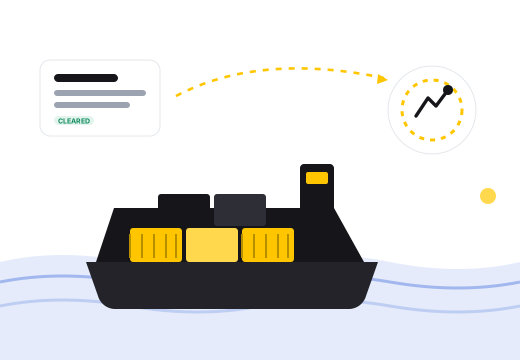
International trade runs on trust — and trust is expensive. Trade finance instruments substitute a bank's credit for the buyer's, so both sides can perform.
A treasury that does not hedge is running three businesses at once: its own, a currency fund and an interest-rate fund. Hedging closes the two you did not plan to run.
| Risk | Typical instrument | What it achieves |
|---|---|---|
| FX exposure | Forward contracts, options | Locks the rate for known future payments or receipts |
| Rate exposure | Interest-rate swaps, FRAs | Converts floating debt cost into a fixed certainty |
| Commodity input | Swaps, capped structures | Puts a ceiling on fuel, energy or raw material spend |
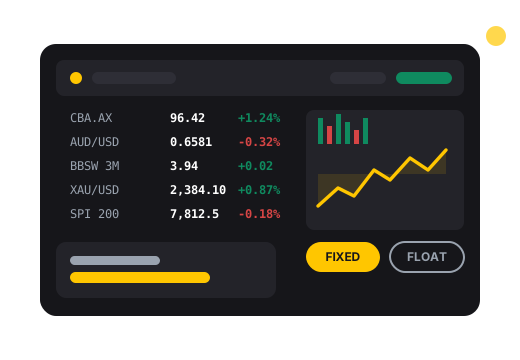
Institutional products carry systemic responsibility. These four controls run underneath every transaction.
Counterparty identity and sanctions screening before any facility opens, refreshed on a risk-based cycle.
Large exposures are approved by committee with documented rationale — never by a single relationship manager.
Payment flows and limit usage are monitored continuously, with automated holds on anomalous instructions.
Regulatory capital and liquidity standards constrain what can be underwritten — a feature, not a bug.
Institutional banking serves large corporates, governments and financial institutions with products such as syndicated lending, trade finance, foreign exchange, hedging and capital markets access.
The buyer's bank commits to pay the seller once the agreed shipping documents are presented. The seller gets payment certainty; the buyer gets proof the goods shipped before money moves.
Hedging locks in an exchange rate for a future payment or receipt using forwards or options, converting currency uncertainty into a known cost so margins can be priced accurately.
Typically companies and organisations above a revenue or balance-sheet threshold, government bodies and regulated financial institutions. Smaller companies are served through business banking.
The About section traces CommBank's history, structure and the principles that guide the platform.